DJI Matrice 5T vs 4T vs Mavic 3T: A Comprehensive Comparison for Enterprise Operators
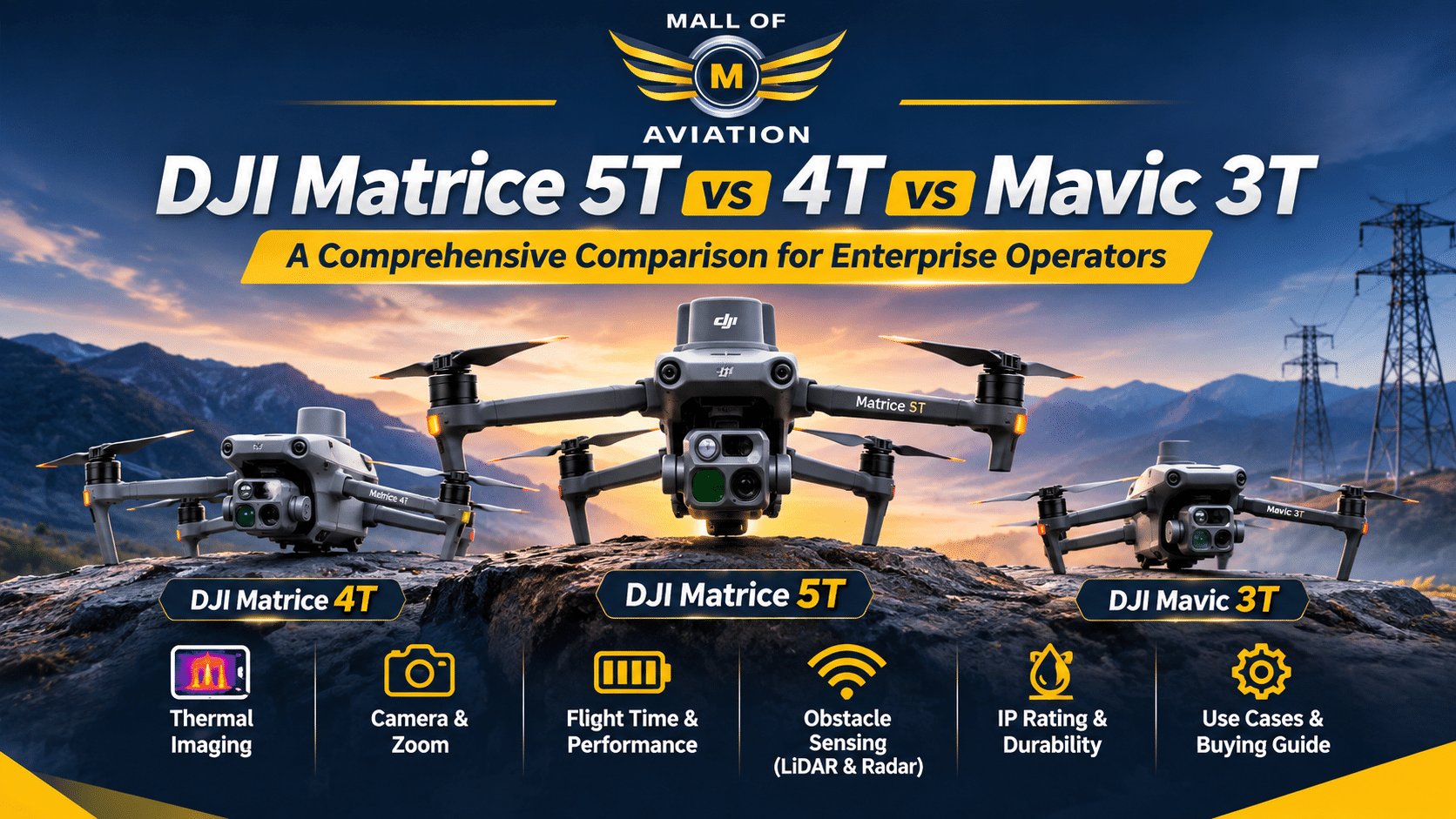
DJI Matrice 5T vs 4T vs 3T: A Comprehensive Comparison for Enterprise Operators
Choosing the right enterprise drone is about more than selecting the newest technology. Businesses, inspection teams and emergency response organisations need an aerial platform that matches their operational requirements, environmental conditions and imaging expectations.
DJI continues to expand its enterprise drone portfolio with advanced thermal imaging, intelligent obstacle detection and professional aerial inspection capabilities. The introduction of the DJI Matrice 5T gives professional operators another option alongside the established DJI Matrice 4T and DJI Mavic 3T.
Although these three drones offer thermal imaging and professional inspection capabilities, they differ significantly in sensor resolution, camera configuration, flight endurance, obstacle sensing and environmental protection.
In this detailed comparison, Mall of Aviation explores the key differences between the DJI Matrice 5T, Matrice 4T and Mavic 3T to help enterprise operators, industrial inspectors, surveyors and public safety professionals make an informed decision.
Note: DJI’s official product name is Mavic 3T, not Matrice 3T. We use the correct product name throughout this comparison.
1. Introduction to DJI Matrice 5T, Matrice 4T and Mavic 3T
DJI Matrice 5T: Advanced Enterprise Thermal Drone
The DJI Matrice 5T is a compact enterprise drone introduced on November 5, 2026. It is designed for demanding operations requiring detailed thermal imaging, enhanced night vision and advanced environmental sensing.
One of its biggest improvements is its native 1280 × 1024 thermal camera, offering four times the pixel count of a standard 640 × 512 thermal sensor. The aircraft also integrates LiDAR, millimetre-wave (mmWave) radar and omnidirectional vision sensing.
With an advertised maximum flight time of 59 minutes and an IP55 protection rating, the Matrice 5T is designed for professional applications such as firefighting, search and rescue, infrastructure inspection and industrial monitoring.
DJI Matrice 4T: Professional Multi-Camera Inspection Platform
The DJI Matrice 4T is a compact enterprise drone featuring three visible-light cameras and a dedicated thermal imaging camera.
Its imaging system includes a 48MP wide-angle camera, a 48MP medium telephoto camera, a 48MP telephoto camera and a 640 × 512 thermal sensor. It also provides a laser rangefinder, night-scene imaging capabilities and intelligent flight assistance features.
With a maximum advertised flight time of 49 minutes using standard propellers, the Matrice 4T offers a useful combination of portability, imaging flexibility and professional inspection capabilities.
DJI Mavic 3T: Portable Enterprise Thermal Drone
The DJI Mavic 3T is part of DJI’s Mavic 3 Enterprise series. It is designed for professionals who need a compact, folding aircraft with both visible-light and thermal imaging capabilities.
It features a 48MP wide-angle camera, a 12MP telephoto camera and a 640 × 512 thermal imaging camera. Its lightweight design makes transportation and deployment convenient for field inspection teams and emergency responders.
With an advertised maximum flight time of 45 minutes, the Mavic 3T remains a practical option for organisations that prioritise portability and reliable thermal inspection capabilities.
2. DJI Matrice 5T vs 4T vs Mavic 3T: Specifications Comparison
The following table highlights the major differences between these three DJI enterprise thermal drones.
| Specifications | DJI Matrice 5T | DJI Matrice 4T | DJI Mavic 3T |
|---|---|---|---|
| Product category | Compact enterprise flagship | Compact enterprise drone | Portable enterprise drone |
| Takeoff weight | 2,239 g | 1,219 g | 920 g |
| Maximum flight time | 59 minutes | 49 minutes | 45 minutes |
| Native thermal resolution | 1280 × 1024 | 640 × 512 | 640 × 512 |
| Enhanced thermal resolution | 2560 × 2048 UHR | 1280 × 1024 Super Resolution | 640 × 512 |
| Wide camera | 50MP | 48MP | 48MP |
| Medium telephoto camera | 50MP | 48MP | Not available |
| Telephoto camera | 50MP | 48MP | 12MP |
| Maximum hybrid zoom | 176× | 112× | 56× |
| Laser rangefinder | Up to 3,000 m | Up to 1,800 m | Not available |
| Obstacle sensing | Vision + LiDAR + mmWave radar | Omnidirectional vision | Omnidirectional vision |
| Ingress protection | IP55 | No standard protection rating | No standard protection rating |
| Operating temperature | -20°C to 50°C | -10°C to 40°C | -10°C to 40°C |
Note: Specifications represent DJI’s published manufacturer data. Flight times are maximum figures under specified controlled test conditions. Actual performance depends on weather, payload, battery condition and operating environment. Enhanced thermal resolutions use supported processing modes and are not equivalent to native sensor resolution.
3. Thermal Imaging: Where the Matrice 5T Leads
Thermal imaging is one of the most important features of an enterprise thermal drone. It allows operators to identify temperature differences and investigate potential problems that may not be visible through conventional cameras.
DJI Matrice 5T
The Matrice 5T features a native 1280 × 1024 infrared thermal sensor with an 8 μm pixel pitch and a 30Hz frame rate. Its Ultra High Resolution (UHR) infrared imaging mode supports output up to 2560 × 2048 at 30fps.
It also features a thermal lens with an f/0.85 aperture and thermal sensitivity of 50 mK or better under DJI’s specified test conditions.
This higher native resolution can help operators identify smaller thermal details, investigate electrical equipment and examine industrial assets where detailed temperature information is important.
DJI Matrice 4T
The Matrice 4T features a 640 × 512 thermal sensor with Super Resolution support up to 1280 × 1024 under supported conditions.
Its thermal imaging system supports spot and area temperature measurement, multiple thermal palettes and thermal video recording. These capabilities make it useful for electrical inspections, solar installations, industrial equipment monitoring and emergency response.
DJI Mavic 3T
The Mavic 3T also features a 640 × 512 thermal imaging sensor. It supports spot temperature measurement, area measurement and multiple thermal colour palettes.
Its thermal camera is suitable for many routine inspection requirements where portability and ease of deployment are important.
Which is better? The Matrice 5T offers a clear advantage in native thermal resolution. However, the Matrice 4T and Mavic 3T can still deliver useful thermal information for applications that do not require the higher native resolution.
4. Camera Systems and Zoom Capabilities
Visible-light camera performance is important when inspecting distant infrastructure, documenting equipment conditions and capturing detailed aerial images.
The Matrice 5T features three 50MP visible-light cameras:
- Wide-angle camera: 50MP sensor with a 23.5mm equivalent focal length.
- Medium telephoto camera: 50MP sensor with a 70mm equivalent focal length.
- Telephoto camera: 50MP sensor with a 252mm equivalent focal length.
It supports up to 176× hybrid zoom, giving operators additional flexibility when observing distant objects.
The Matrice 4T also offers three visible-light cameras, each with 48MP effective pixels. Its camera system includes a wide-angle camera, a 70mm equivalent medium telephoto camera and a 168mm equivalent telephoto camera. It supports up to 112× hybrid zoom.
The Mavic 3T combines a 48MP wide-angle camera with a 12MP telephoto camera. Its telephoto system supports up to 56× hybrid zoom.
For organisations that regularly inspect distant structures or require multiple focal lengths, the Matrice 5T and Matrice 4T provide more versatile camera configurations.
5. Flight Time and Operational Efficiency
Flight endurance directly influences how much inspection or monitoring work a drone can complete during a mission.
- DJI Matrice 5T: Up to 59 minutes.
- DJI Matrice 4T: Up to 49 minutes with standard propellers.
- DJI Mavic 3T: Up to 45 minutes with the specified standard battery and propellers.
The Matrice 5T offers the longest advertised flight time among these three platforms. This can be useful for extended inspections, large industrial sites and longer emergency response missions.
However, maximum flight time should not be treated as the expected duration of every real-world mission. Wind, temperature, payload, flight speed and required battery reserves all affect actual endurance.
6. Obstacle Avoidance and Flight Safety
Obstacle sensing is particularly important when operating around buildings, power lines, trees and industrial infrastructure.
DJI Matrice 5T
The Matrice 5T combines a six-directional vision system, rotating LiDAR and three-directional mmWave radar.
DJI specifies a forward mmWave radar detection range of up to 40 metres when facing a 10mm black insulated wire under specified conditions. Its rotating LiDAR also provides additional obstacle detection capabilities, including support for certain power-line detection scenarios.
DJI Matrice 4T
The Matrice 4T uses an omnidirectional vision sensing system and intelligent flight assistance features. Its sensing system helps the aircraft detect surrounding obstacles during supported flight operations.
DJI Mavic 3T
The Mavic 3T uses an omnidirectional binocular vision system supplemented by a downward infrared sensor. This provides obstacle sensing support for many routine inspection and field operations.
While the Matrice 5T offers a more advanced combination of sensing technologies, obstacle detection should never replace pilot awareness, proper mission planning or safe operating procedures.
7. Environmental Protection and Operating Conditions
Environmental resistance is an important consideration for professional operators working in dusty industrial areas, outdoor infrastructure sites and changing weather conditions.
The DJI Matrice 5T carries an IP55 protection rating and has a specified operating temperature range of -20°C to 50°C under the manufacturer’s stated conditions.
The Matrice 4T and Mavic 3T do not have a standard ingress protection rating. Their specified aircraft operating temperature range is -10°C to 40°C.
For organisations operating in challenging environmental conditions, the Matrice 5T offers an important advantage. However, an IP55 rating does not mean unrestricted operation in heavy rain or extreme weather. Operators should always follow DJI’s environmental limitations and safety instructions.
8. Communication Range and Connectivity
Reliable video transmission is essential for enterprise drone operations, particularly when inspecting large industrial facilities or monitoring distant infrastructure.
The DJI Matrice 5T uses O4 Enterprise video transmission and supports advanced relay functionality for supported operations. The Matrice 4T also uses O4 Enterprise transmission, while the Mavic 3T uses the O3 Enterprise transmission system.
Actual communication performance depends on operating frequency, local regulations, interference, terrain, obstacles and environmental conditions.
Operators should consult DJI’s regional specifications and applicable local aviation requirements before planning long-distance missions. Advertised transmission distances should not be interpreted as guaranteed operational ranges.
9. Accessories and Payload Capabilities
Enterprise accessories can expand the usefulness of a drone by supporting additional inspection, communication and emergency response workflows.
The Matrice 5T offers three E-Port connections and a maximum payload capacity of 400g. It supports compatible accessories such as the DJI AL2 SpotLight and DJI AS2 Speaker.
The AS2 Speaker supports a maximum volume of 120 dB at one metre and an advertised effective broadcast distance of up to 400 metres under specified laboratory conditions. These accessories can support search-and-rescue coordination, emergency announcements and night operations.
The Matrice 4T also supports compatible enterprise accessories, including the DJI AL1 Spotlight and DJI AS1 Speaker. The Mavic 3T supports a more limited accessory ecosystem, including compatible enterprise accessories such as its speaker and RTK module.
Before purchasing any accessory, operators should verify aircraft compatibility, installation requirements, payload limitations and supported firmware versions.
10. Best Applications for Each DJI Enterprise Drone
DJI Matrice 5T: Advanced Industrial and Emergency Operations
- Electrical infrastructure and power-line inspections.
- Industrial equipment thermal monitoring.
- Firefighting and emergency response.
- Search-and-rescue operations.
- Night-time monitoring and situational awareness.
- Infrastructure inspections in challenging environmental conditions.
- Large-scale inspection projects requiring detailed thermal imagery.
DJI Matrice 4T: Professional Inspection and Public Safety
- Electrical substation inspections.
- Solar panel and industrial thermal inspections.
- Infrastructure and bridge monitoring.
- Search-and-rescue operations.
- Law enforcement and public safety missions.
- Routine industrial asset inspections.
DJI Mavic 3T: Portable Field Operations
- Small and medium-scale infrastructure inspections.
- Building and rooftop thermal inspections.
- Fire detection and emergency response.
- Thermal monitoring of equipment.
- Security and monitoring operations.
- Portable aerial inspection requirements.
11. Which DJI Enterprise Drone Should You Choose?
The right drone depends on your inspection requirements, available budget, working environment and the level of imaging detail your operations demand.
Choose the DJI Matrice 5T if:
- Your organisation needs higher native thermal imaging resolution.
- You require LiDAR and mmWave radar alongside vision sensing.
- Your operations benefit from longer advertised flight endurance.
- You need IP55-rated environmental protection.
- You conduct demanding industrial inspections, firefighting or search-and-rescue operations.
Choose the DJI Matrice 4T if:
- You need a professional multi-camera thermal inspection platform.
- Your work requires a laser rangefinder and multiple optical focal lengths.
- You want a balance of portability and enterprise imaging capabilities.
- Your operations can be completed using 640 × 512 native thermal imaging.
- You regularly perform infrastructure inspections and public safety missions.
Choose the DJI Mavic 3T if:
- Portability and convenient transportation are your priorities.
- You need a compact enterprise thermal drone for field operations.
- Your inspections can be completed using 640 × 512 native thermal imaging.
- You require visible-light and thermal imaging in one compact aircraft.
- You prioritise quick deployment for routine inspection tasks.
12. Final Verdict: DJI Matrice 5T vs Matrice 4T vs Mavic 3T
The DJI Matrice 5T, Matrice 4T and Mavic 3T each offer different advantages for professional drone operators.
The DJI Matrice 5T is the strongest option on paper for organisations requiring higher native thermal resolution, integrated LiDAR, mmWave radar, IP55 protection and extended flight endurance.
The DJI Matrice 4T remains a capable enterprise platform, combining three visible-light cameras, thermal imaging, laser ranging and professional inspection features.
The DJI Mavic 3T is a practical choice for operators who prioritise a lightweight folding design, convenient transportation and dependable thermal imaging capabilities.
Ultimately, the best enterprise drone is the one that matches your mission requirements, operating environment and long-term business objectives. Consider the complete operating cost, accessories, batteries, training and after-sales support before making a purchasing decision.
Explore Drone Technology and Components with Mall of Aviation
At Mall of Aviation, we understand the importance of selecting suitable drone technology and components for reliable aerial operations. Whether you are exploring enterprise UAV platforms, flight controllers, drone accessories, replacement components or professional drone equipment, choosing the right hardware is essential.
Explore our range of drone products and accessories at Mall of Aviation.
For product-related enquiries or assistance identifying suitable drone components, contact our team.
Explore the official manufacturer information: DJI Matrice 5T.
Frequently Asked Questions (FAQs)
1. What is the main difference between DJI Matrice 5T and Matrice 4T?
The main difference is thermal imaging and integrated sensing. The Matrice 5T features a native 1280 × 1024 thermal sensor, while the Matrice 4T uses a native 640 × 512 thermal sensor with Super Resolution support up to 1280 × 1024. The Matrice 5T also integrates LiDAR, mmWave radar and IP55-rated protection.
2. Is DJI Matrice 5T suitable for night operations?
Yes. The Matrice 5T combines thermal imaging, enhanced night vision, NIR illumination and advanced obstacle sensing to support suitable low-light operations.
3. How long can DJI Matrice 5T fly?
DJI advertises a maximum flight time of up to 59 minutes under specified windless test conditions without payloads. Actual flight time depends on operating conditions, accessories and flight mode.
4. Is DJI Mavic 3T the same as Matrice 3T?
No. DJI’s official product name is Mavic 3T. It belongs to the DJI Mavic 3 Enterprise series and should not be confused with the Matrice product family.
5. Which drone is better for thermal inspections?
The Matrice 5T offers higher native thermal resolution and is particularly suitable when detailed thermal imagery is a priority. The Matrice 4T and Mavic 3T remain useful for many inspection applications that can be handled with 640 × 512 native thermal imaging.
6. Can these drones be used for industrial inspections?
Yes. All three platforms offer thermal and visible-light imaging capabilities that can support suitable industrial inspection workflows. The right choice depends on the inspection target, required image detail, environmental conditions and operational requirements.
7. Does the DJI Matrice 5T have waterproof protection?
The Matrice 5T has an IP55 rating for dust and water resistance under specified laboratory test conditions. This does not mean it is waterproof or suitable for unrestricted operation in heavy rain. Always follow DJI’s operating instructions.
8. Which drone offers the longest flight time?
The DJI Matrice 5T offers the longest advertised maximum flight time among these three drones, at up to 59 minutes, compared with up to 49 minutes for the Matrice 4T and 45 minutes for the Mavic 3T under their respective specified test conditions.