
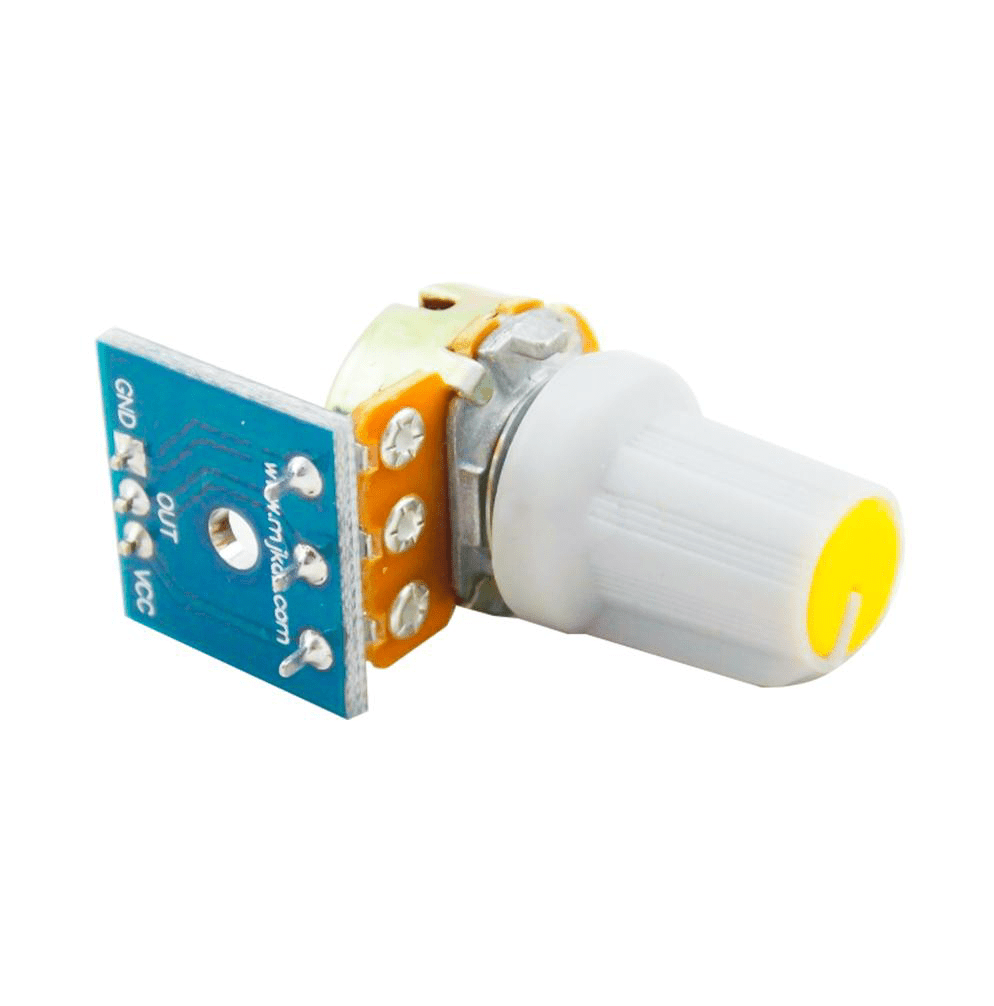
10K Potentiometer Module
10K potentiometer module is a compact and reliable analog input device used for adjusting voltage levels in Arduino and electronics projects. It provides smooth and precise control, making it ideal for applications like LED brightness control, motor speed adjustment, and sensor calibration.
- Estimated Delivery : Up to 4 business days
10K Potentiometer Module for Arduino & Electronics Projects
A 10K potentiometer module is one of the most practical and beginner-friendly components in the world of electronics. Designed to provide smooth, adjustable analog input, this compact module is an essential building block for hobbyists, students, and engineers working on Arduino projects, DIY circuits, and embedded systems.
Unlike fixed resistors, the 10K potentiometer module lets you manually control voltage levels by simply turning a knob — no code changes or additional hardware required. Whether you need to dim an LED, regulate motor speed, or calibrate a sensor, it delivers consistent and precise analog control in a ready-to-use PCB format.
How the 10K Potentiometer Module Works
This module operates on a simple but effective principle. It contains a resistive track connected between two outer terminals — one tied to VCC and the other to GND. A third center terminal, known as the wiper, slides along this track as the knob is rotated, producing a variable voltage output between 0V and the supply voltage.
When connected to the analog input pin of a microcontroller such as an Arduino, the wiper’s position is read as a value between 0 and 1023 (using a 10-bit ADC). This value can then be mapped to control anything from servo angles to audio volume levels. The pre-mounted PCB design simplifies wiring and makes integration into breadboards and custom circuits straightforward.
For a deeper understanding of how potentiometers work in circuits, you can refer to resources like the Arduino official analog input tutorial or the Electronics Tutorials guide on potentiometers.
Key Features
- High-precision 10K ohm resistive element for smooth analog adjustment
- Pre-mounted on a compact PCB with labeled output pins
- Stable and noise-filtered analog output signal
- Compatible with Arduino, Raspberry Pi, ESP32, and most microcontrollers
- Simple 3-pin interface (VCC, GND, Signal)
- Lightweight and compact — ideal for embedded and portable builds
Applications of the 10K Potentiometer Module
This versatile component finds use across a wide range of projects and industries. In maker and hobbyist communities, the 10K potentiometer module is frequently used for LED brightness control, servo motor positioning, and audio volume adjustment in DIY amplifier setups. In robotics, it helps tune PID parameters or control actuator speed in real time without reprogramming the microcontroller.
Beyond hobbyist use, this type of analog input component is common in industrial control panels, test and measurement equipment, and educational electronics kits. It is also widely used in sensor calibration rigs, where a manual reference voltage is needed for baseline testing.
- LED and display brightness control
- DC and servo motor speed regulation
- Audio volume and tone adjustment
- Sensor calibration and signal testing
- Robotics and automation prototyping
- Educational electronics and STEM projects
If you are working on a more complex build, consider pairing this component with related items from our electronics modules collection or browsing our range of sensors for a complete prototyping solution.
Advantages Over Direct Wiring
Using a 10K potentiometer module rather than a bare potentiometer offers several practical advantages. The PCB mounting protects solder joints from mechanical stress when the knob is turned repeatedly, extending the component’s lifespan. The clearly labeled pins eliminate wiring confusion, which is especially helpful during rapid prototyping. Additionally, the compact form factor fits neatly on standard breadboards or can be screwed into project enclosures using the onboard mounting holes.
For beginners, this means less time troubleshooting and more time building. For experienced builders, it means faster iteration and a cleaner final assembly.
Technical Specifications
- Resistance: 10K Ohm
- Output Signal: Analog
- Operating Voltage: 5V DC
- Dimensions: 18mm (L) × 23mm (W) × 25mm (H)
- Weight: 8 grams
Package Includes
- 1 × 10K Potentiometer Module
Quick Setup with Arduino
Getting started with the 10K potentiometer module is simple. Connect the left outer pin to 5V, the right outer pin to GND, and the center pin to analog pin A0 on your Arduino board. Upload a basic analog read sketch, open the Serial Monitor, and rotate the knob — you will see values change from 0 to 1023 in real time. From there, use the map() function to scale those values to your desired output range, whether that is PWM duty cycle for motor control or degrees for a servo.
Why Buy the 10K Potentiometer Module from Mall of Aviation
At Mall of Aviation, every component we stock is selected for build quality, accurate specifications, and reliable performance. We cater to a broad audience — from students just starting out with their first Arduino kit to engineers building production-ready prototypes. Our products are dispatched carefully packed to prevent damage, and our team is available to assist with compatibility questions and project guidance.
When you shop with us, you are not just buying a component — you are getting a dependable part of your next successful build.
Frequently Asked Questions (FAQ)
What is a 10K potentiometer module used for?
It is used to provide variable analog input in electronic circuits, enabling manual control over voltage levels for applications like brightness adjustment, motor speed regulation, and signal calibration.
Is this module compatible with Arduino?
Yes. It connects directly to any Arduino analog input pin and works with the standard analogRead() function without any additional libraries.
Can beginners use this component?
Absolutely. The pre-mounted PCB, labeled pins, and simple 3-wire connection make the 10K potentiometer module one of the most beginner-accessible analog components available.
What voltage does it operate at?
It is designed for 5V DC operation, making it compatible with most common microcontroller development boards.
Does it work with Raspberry Pi or ESP32?
Yes, it can be used with any microcontroller or single-board computer that has an analog input pin or an external ADC module.
Add a review
Related products
-
-
LINE Cable
₹400 -
-
Radio Module
₹12,000
Reviews
There are no reviews yet.