Shaurya Squadrons Explained: India’s Drone-Powered Armoured Units
Defense Technology & FPV Drone Insights
Shaurya Squadrons Drone Armoured Units India: 7 Powerful Innovations Transforming Modern Warfare
Mall of Aviation • Defence Technology Deep Dive 2026
Quick Summary:
Shaurya Squadrons Drone Armoured Units India represent a revolutionary leap in modern warfare, integrating unmanned aerial systems directly into armoured regiments. These specialized units enhance battlefield surveillance, enable precision strikes, and create a seamless sensor-to-shooter loop that reduces reaction time from minutes to seconds. This comprehensive guide from Mall of Aviation explores how these drone-powered formations are reshaping India’s military capabilities.
The landscape of modern warfare is undergoing a profound transformation, and at the heart of this evolution lies the strategic integration of drones into frontline combat units. To understand how FPV drones are used in real-world applications, you can explore this complete FPV drone guide. Shaurya Squadrons Drone Armoured Units India represent one of the most significant doctrinal shifts in the Indian Army’s history, bringing advanced unmanned aerial capabilities directly to armoured regiments. These specialized sub-units are designed to serve as force multipliers, providing real-time intelligence, precision strike capabilities, and enhanced battlefield awareness that traditional reconnaissance methods simply cannot match.
In this detailed analysis from Mall of Aviation, we explore everything you need to know about Shaurya Squadrons Drone Armoured Units India, from their operational structure and core capabilities to their role in reshaping future battlefield dynamics. Whether you are a defence enthusiast, a military technology researcher, or simply curious about India’s growing drone capabilities, this guide provides comprehensive insights into one of the most innovative military developments in recent years. This is in line with latest India Drone Policy 2030 and defence strategy.
Table of Contents
- Introduction to Shaurya Squadrons
- Exercise Amogh Jwala Overview
- Concept and Structural Framework
- Core Capabilities of Shaurya Squadrons
- The Sensor-to-Shooter Loop
- Integration with Armoured Units
- Comparison with Ashni Platoons
- Drone Technologies Used
- Doctrinal Shift in Modern Warfare
- Future of Armoured Warfare
- Challenges and Limitations
- Conclusion
- Frequently Asked Questions
Introduction to Shaurya Squadrons Drone Armoured Units India
The concept of Shaurya Squadrons Drone Armoured Units India emerged from the urgent need to modernize conventional warfare tactics. Traditional armoured regiments, while formidable, often face significant limitations in battlefield awareness and reconnaissance capabilities. The introduction of dedicated drone sub-units addresses these gaps by providing real-time aerial surveillance, precision targeting, and enhanced situational awareness directly at the tactical level.
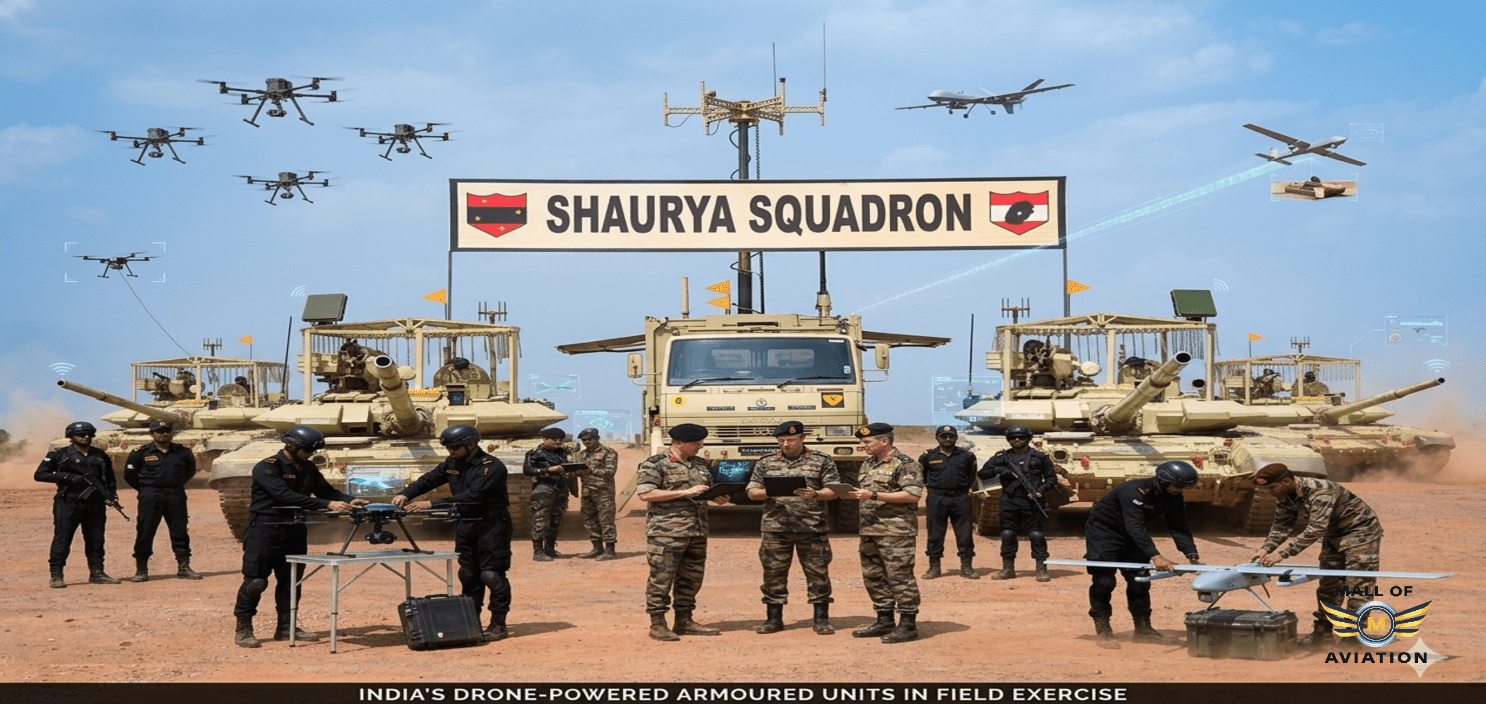
Each Shaurya Squadron functions as an independent operational entity within an armoured regiment, equipped with a mix of surveillance drones, attack drones, and loitering munitions. Unlike traditional reconnaissance methods that rely on ground patrols and manned aircraft, these drone-enabled units can operate continuously, providing commanders with uninterrupted battlefield intelligence. This marks a fundamental shift from manpower-intensive operations to technology-driven warfare, where Shaurya Squadrons Drone Armoured Units India serve as the eyes and ears of frontline forces.
Exercise Amogh Jwala: The Proving Ground
The operational viability of Shaurya Squadrons Drone Armoured Units India was rigorously tested during Exercise Amogh Jwala, a large-scale military exercise conducted at the Babina Field Firing Ranges. This 13-day drill brought together tanks, infantry combat vehicles, helicopters, fighter aircraft, and specialized drone units in a multi-domain combat environment. The exercise validated the effectiveness of integrating drone capabilities with mechanized forces, demonstrating how Shaurya Squadrons Drone Armoured Units India can operate seamlessly alongside traditional armoured assets.
Key takeaways from Exercise Amogh Jwala included:
- Successful coordination between drone units and armoured regiments
- Reduced sensor-to-shooter response times
- Enhanced situational awareness across the battlefield
- Improved safety for frontline soldiers through remote reconnaissance
These results confirmed that Shaurya Squadrons Drone Armoured Units India are not just a theoretical concept but a practical, deployable asset capable of transforming battlefield operations.
Concept and Structural Framework
Understanding the organizational structure of Shaurya Squadrons Drone Armoured Units India is essential to appreciating their operational effectiveness. Each Shaurya Squadron is composed of approximately 25 to 30 highly trained personnel specializing in drone operations, electronic warfare, and counter-drone tactics. This lean, specialized structure allows these units to operate independently at the tactical level while remaining fully integrated with the larger armoured regiment.
The squadron’s equipment inventory includes:
- Surveillance Drones: Medium-altitude, long-endurance UAVs for persistent battlefield monitoring
- Attack Drones: Armed unmanned systems capable of precision strikes against enemy assets
- Loitering Munitions: Kamikaze drones that can loiter over target areas before engaging. FPV are doing amazing wonders in this domain.
- Counter-Drone Systems: Electronic warfare tools to detect and neutralize hostile drones
This diverse equipment mix ensures that Shaurya Squadrons Drone Armoured Units India can perform multiple roles, from intelligence gathering to offensive operations, without requiring support from external assets.
Core Capabilities of Shaurya Squadrons
The operational value of Shaurya Squadrons Drone Armoured Units India lies in their diverse range of capabilities. These units are designed to perform multiple roles on the modern battlefield, each contributing to overall combat effectiveness.
Real-Time Surveillance and Reconnaissance
Drones within Shaurya Squadrons provide continuous aerial surveillance, offering commanders real-time battlefield imagery that traditional reconnaissance methods cannot match. This persistent awareness enables faster decision-making and more effective resource allocation.
Precision Strike Capability
Armed drones and loitering munitions allow Shaurya Squadrons Drone Armoured Units India to engage enemy targets with surgical precision. This minimizes collateral damage while maximizing combat effectiveness against high-value targets.
Electronic Warfare Support
Beyond offensive operations, these squadrons also provide critical electronic warfare capabilities, including signal jamming, drone detection, and counter-UAS operations. This defensive layer protects both the squadron and the larger armoured formation from enemy drone threats.
Battlefield Damage Assessment
After strikes, drones can perform immediate damage assessment, allowing commanders to evaluate mission success and adjust follow-on operations without deploying ground troops into potentially dangerous areas.
The Sensor-to-Shooter Loop: Reducing Response Time
One of the most significant advantages of Shaurya Squadrons Drone Armoured Units India is their ability to drastically reduce the sensor-to-shooter loop. In traditional warfare, the time between detecting a target and engaging it can span several minutes or even hours, involving multiple layers of communication and coordination. With drones integrated directly into armoured regiments, this loop is compressed to mere seconds.
This rapid response capability translates to:
-
- Faster Target Acquisition: Drones identify and track targets continuously
- Instant Strike Execution: Attack drones or loitering munitions can engage immediately
- Improved Battlefield Efficiency: Reduced lag between detection and destruction
- Enhanced Survivability: Enemy forces have less time to react or reposition
For Shaurya Squadrons Drone Armoured Units India, this capability represents a fundamental shift in how armoured warfare is conducted, turning conventional tanks and infantry into components of a larger, integrated kill chain.
Integration with Armoured Units
The true strength of Shaurya Squadrons Drone Armoured Units India lies in their seamless integration with traditional armoured assets. Rather than operating as separate entities, these drone units function as organic components of the armoured regiment, providing capabilities that enhance the effectiveness of tanks and infantry combat vehicles.
Key integration benefits include:
- Enhanced Situational Awareness: Tank commanders receive real-time drone feeds, enabling them to see beyond their immediate line of sight
- Reduced Soldier Risk: Reconnaissance missions that previously required ground patrols are now conducted by drones
- Improved Operational Flexibility: Armoured units can adapt more quickly to changing battlefield conditions
- Extended Operational Range: Drones provide visibility and strike capabilities far beyond the regiment’s physical position
This integration ensures that Shaurya Squadrons Drone Armoured Units India enhance rather than replace traditional armoured capabilities, creating a more versatile and effective fighting force.
Comparison with Ashni Platoons
Before the introduction of Shaurya Squadrons Drone Armoured Units India, the Indian Army had already experimented with drone integration in infantry units through the Ashni Platoon concept. While both initiatives share common goals, there are distinct differences in their structure and application.
Similarities between Shaurya Squadrons and Ashni Platoons:
- Drone-based operations as force multipliers
- Tactical independence from higher command structures
- Enhanced strike and surveillance capabilities
- Focus on reducing soldier risk through remote operations
Key differences:
- Shaurya Squadrons are specifically designed for armoured warfare, integrating with tanks and mechanized infantry
- Ashni Platoons are tailored for light infantry and special operations
- Equipment profiles differ, with Shaurya Squadrons utilizing heavier, longer-range drones suited for open battlefield conditions
Both concepts represent the Indian Army’s commitment to leveraging drone technology across all combat arms, with Shaurya Squadrons Drone Armoured Units India representing the latest evolution in this ongoing modernization effort.
Drone Technologies Deployed by Shaurya Squadrons
The operational effectiveness of Shaurya Squadrons Drone Armoured Units India depends heavily on the advanced technologies they employ. These squadrons utilize a diverse range of unmanned systems, each selected for specific operational roles.
Surveillance and Reconnaissance UAVs
These medium-altitude, long-endurance drones provide persistent battlefield monitoring, capable of loitering over areas of interest for extended periods. Equipped with advanced electro-optical and infrared sensors, they can track enemy movements day or night, feeding real-time intelligence. This level of control depends heavily on reliable FPV transmitters and receivers to armoured commanders.
Loitering Munitions
Also known as kamikaze drones, these systems can loiter over the battlefield, identify high-value targets, and execute precision strikes with minimal warning. For Shaurya Squadrons Drone Armoured Units India, loitering munitions offer a low-risk, high-precision engagement option against enemy armour, artillery, and command posts.
FPV Attack Drones
First-person view attack drones provide close-range strike capabilities, allowing operators to guide munitions directly onto targets with exceptional accuracy. These systems are particularly effective against moving targets and in complex terrain where larger drones may face limitations.
Counter-Drone Systems
Recognizing that drones are not only offensive tools but also threats, Shaurya Squadrons are equipped with counter-UAS technologies. These include signal jammers, detection radars, and electronic warfare systems designed to detect, track, and neutralize hostile drones before they can threaten friendly forces.
The establishment of Shaurya Squadrons Drone Armoured Units India represents more than just the introduction of new equipment; it signals a fundamental doctrinal shift in how the Indian Army approaches warfare. Historically, armoured operations relied heavily on manned reconnaissance, extensive ground patrols, and significant manpower to achieve battlefield awareness. The drone-enabled model fundamentally changes this equation.
This doctrinal evolution includes:
- Technology-Centric Operations: Drones and unmanned systems are no longer support assets but central components of combat operations
- Distributed Lethality: The ability to engage targets across a wider battlefield using remote systems
- Risk Mitigation: Reducing soldier exposure to danger through remote and autonomous systems
- Networked Warfare: Seamless integration of sensors, shooters, and command elements into a unified battlefield network
For Shaurya Squadrons Drone Armoured Units India, this doctrinal shift ensures that the Indian Army remains competitive in an era where technology increasingly determines battlefield outcomes.
The Future of Armoured Warfare
The success of Shaurya Squadrons Drone Armoured Units India points toward an exciting future for armoured warfare. As drone technology continues to evolve, we can expect to see further integration of unmanned systems with traditional armoured platforms.
Emerging developments likely to shape the future include:
- Autonomous Tanks: Unmanned or optionally-manned armoured vehicles operating alongside drone units
- AI-Driven Targeting Systems: Artificial intelligence assisting in target identification and engagement prioritization
- Swarm Drone Tactics: Coordinated swarms of drones capable of overwhelming enemy defenses
- Enhanced Electronic Warfare: Integrated EW capabilities protecting armoured formations from drone attacks
The lessons learned from deploying Shaurya Squadrons Drone Armoured Units India will inform these future developments, ensuring that Indian armoured forces remain at the forefront of military innovation.
Challenges and Limitations
While Shaurya Squadrons Drone Armoured Units India offer tremendous advantages, they also face significant challenges that must be addressed to realize their full potential.
Electronic Warfare Threats
Adversaries with advanced electronic warfare capabilities can jam or spoof drone signals, potentially neutralizing the squadron’s effectiveness. Ongoing investment in anti-jamming technologies and autonomous navigation is essential to mitigate this risk.
Battery performance is a critical factor, especially when using LiPo batteries in FPV drones.
Current drone technologies face limitations in flight endurance, particularly for smaller tactical systems. This affects the squadron’s ability to maintain persistent surveillance over extended operations.
Training and Skill Requirements
Operating advanced drone systems requires extensive training. Maintaining a pipeline of skilled operators for Shaurya Squadrons Drone Armoured Units India is an ongoing challenge that requires sustained investment in training infrastructure.
Integration with Legacy Systems
Integrating new drone capabilities with existing armoured platforms and communication networks presents technical challenges that require careful planning and execution.
Conclusion: The New Era of Armoured Warfare
Shaurya Squadrons Drone Armoured Units India represent a paradigm shift in how the Indian Army approaches modern warfare. By integrating advanced drone capabilities directly into armoured regiments, these units provide unprecedented battlefield awareness, precision strike capabilities, and operational flexibility. The successful validation of this concept during Exercise Amogh Jwala demonstrates that drone-enabled armoured warfare is not merely theoretical but operationally viable.
As the Indian Army continues to modernize, the lessons learned from deploying Shaurya Squadrons Drone Armoured Units India will inform broader doctrinal evolution. From autonomous systems to AI-driven targeting, the future of armoured warfare will be increasingly technology-driven, with drones playing an ever more central role. For defence enthusiasts and military professionals alike, the Shaurya Squadrons represent a fascinating glimpse into the future of combat operations.
At Mall of Aviation, we will continue to track and analyze these developments, providing insights into how drone technology is reshaping military capabilities. For more information on military drone applications, explore our related guides on
UAV detection systems and military drone technology and advanced drone autonomy using optical flow and LiDAR.
Frequently Asked Questions About Shaurya Squadrons Drone Armoured Units India
What are Shaurya Squadrons Drone Armoured Units India?
Shaurya Squadrons Drone Armoured Units India are specialized drone-equipped sub-units integrated within armoured regiments. They provide real-time surveillance, precision strike capabilities, and enhanced battlefield awareness to frontline forces.
Where were Shaurya Squadrons first tested?
The concept was validated during Exercise Amogh Jwala, a 13-day military exercise conducted at the Babina Field Firing Ranges. The exercise demonstrated the effectiveness of integrating drone units with mechanized forces.
What is the primary role of Shaurya Squadrons?
The primary roles include real-time battlefield surveillance, precision strike against enemy targets, reconnaissance missions, and electronic warfare support for armoured formations.
How many personnel are in a Shaurya Squadron?
Each Shaurya Squadron typically consists of approximately 25 to 30 highly trained personnel specializing in drone operations, electronic warfare, and counter-drone tactics.
What types of drones are used in Shaurya Squadrons?
The squadrons utilize a mix of surveillance drones, attack drones, loitering munitions, and counter-drone systems, enabling multi-role operations across the battlefield.
What is the sensor-to-shooter loop and why is it important?
The sensor-to-shooter loop refers to the time between detecting a target and engaging it. Shaurya Squadrons Drone Armoured Units India reduce this loop from minutes to seconds, enabling faster, more effective responses to emerging threats.
How do Shaurya Squadrons differ from Ashni Platoons?
While both concepts integrate drones into combat units, Shaurya Squadrons are specifically designed for armoured warfare, operating alongside tanks and mechanized infantry. Ashni Platoons are tailored for light infantry and special operations.
What are the main challenges facing Shaurya Squadrons?
Key challenges include electronic warfare threats, battery endurance limitations, extensive training requirements, and integration with legacy armoured systems.
What is the future of Shaurya Squadrons?
The concept is expected to expand across more armoured regiments, with future developments likely including autonomous systems, AI-driven targeting, and swarm drone tactics.
Where can I learn more about military drone applications?
Mall of Aviation offers comprehensive resources on military drone technology, including FPV Drone Applications in Defence and The Evolution of Loitering Munitions. For official information, refer to the Indian Army Official Website and DRDO.