Using LiPo Batteries for FPV Drones
Using LiPo Batteries for FPV Drones: 7 Powerful Safety Tips for Beginners
Mall of Aviation • Complete Beginner Guide 2026
LiPo batteries are the heart and soul of every FPV drone. Without them, your quad is just a collection of carbon fiber and electronics.
Learning using LiPo batteries for FPV drones correctly is the single most important skill you can develop as a pilot. It determines not only how long you stay in the air but also how safe your entire flying experience will be.
In this comprehensive guide from Mall of Aviation, we will cover everything you need to know—from battery basics and voltage to charging safety, storage practices, and the 7 powerful safety tips that every beginner must follow.
Whether you are building your first drone or looking to refine your battery management skills, this guide will give you the confidence to handle LiPo batteries like a pro.
Table of Contents
- Battery Recommendations
- Understanding LiPo Basics
- Voltage, Cell Count & Capacity
- C Rating & Internal Resistance
- Choosing the Right LiPo Battery
- Charging LiPo Batteries Safely
- Storage & Maintenance
- 7 Powerful Safety Rules for Using LiPo Batteries
- Lifespan & Disposal
- Frequently Asked Questions
- Conclusion
Battery Recommendations for FPV Drones
When it comes to using LiPo batteries for FPV drones, choosing a reliable brand is essential. Cheap, unknown batteries often have inconsistent quality and can be dangerous. Here are our top recommendations:
Best for 5 Inch FPV Drones
- GNB (Gaoneng) – Excellent value and consistent performance
- Tattu R-Line – Premium performance for racing and freestyle
- CNHL / Dogcom – Budget-friendly high output batteries
- BetaFPV Lava – Reliable for everyday flying
For 6S setups, choose between 1000mAh to 1300mAh. For 4S setups, go with 1300mAh to 1500mAh.
Best for 3 Inch & Micro Drones
For smaller builds, use packs ranging from 650mAh to 850mAh depending on frame size and motor efficiency. Brands like GNB and Tattu offer excellent micro battery options.
Understanding LiPo Battery Basics
Before mastering using LiPo batteries for FPV drones, you need to understand what makes them special. LiPo stands for Lithium Polymer. These batteries are preferred in the FPV community because they offer:
- High energy density: More power in a smaller, lighter package
- High discharge rates: Ability to deliver sudden bursts of power for aggressive maneuvers
- Lightweight design: Critical for achieving optimal thrust-to-weight ratio
Unlike traditional batteries, LiPo cells are soft and flexible, which allows them to be shaped to fit various drone frames. However, this also makes them more susceptible to physical damage if not handled carefully.
Voltage, Cell Count & Capacity Explained
Understanding voltage is fundamental to using LiPo batteries for FPV drones correctly.
Voltage Per Cell
- Fully charged: 4.2V per cell
- Storage voltage: 3.8V per cell
- Minimum safe voltage: 3.0V per cell (absolute minimum)
- Landing voltage: 3.5V per cell for safe operation
Never discharge a LiPo cell below 3.0V. Doing so causes irreversible chemical damage and can make the battery unsafe to recharge.
Cell Count (S Rating)
The “S” value represents how many cells are connected in series. Common configurations:
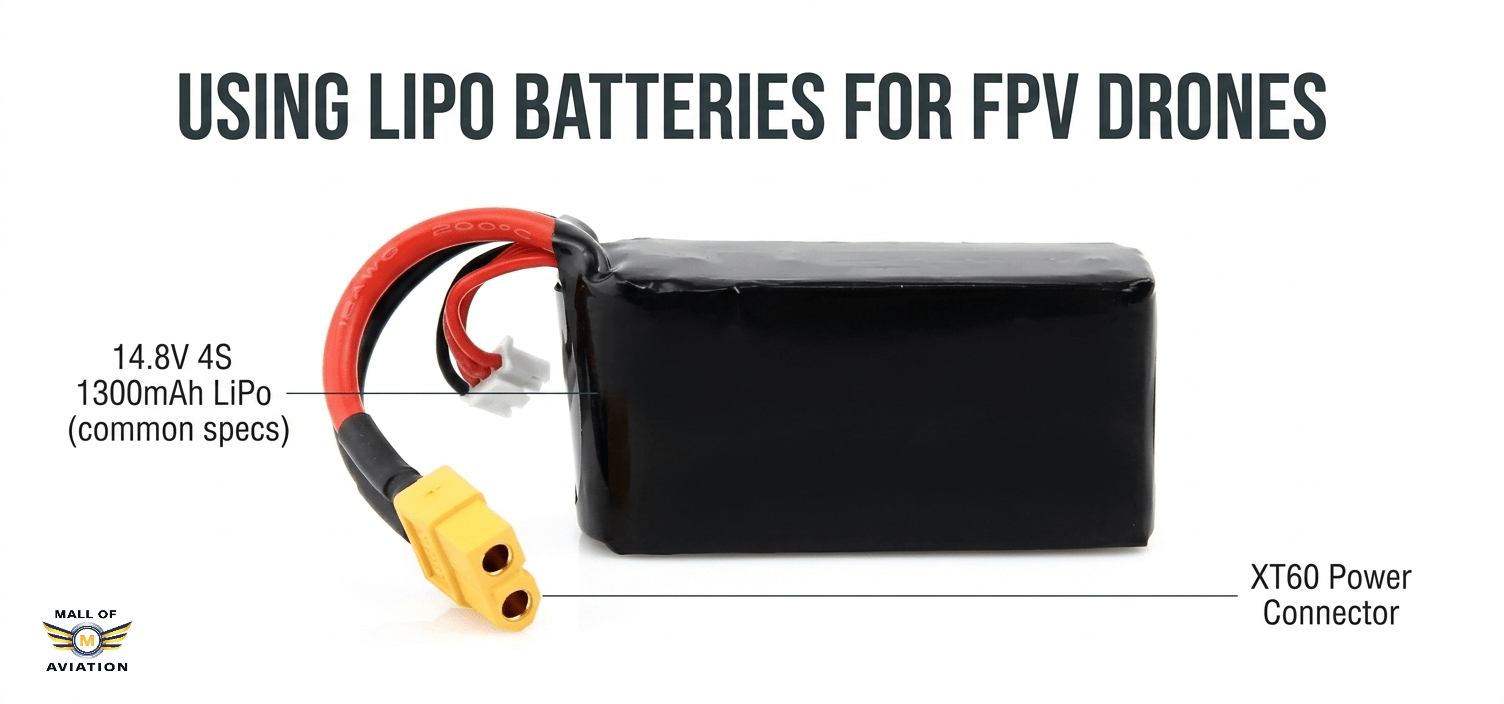
- 4S: 14.8V nominal (4 cells) – Ideal for 5 inch beginner setups
- 6S: 22.2V nominal (6 cells) – Standard for modern 5 inch freestyle and racing
- 8S: 29.6V nominal (8 cells) – Used for long-range and heavy-lift drones
Higher voltage means more power and efficiency, but also puts more stress on your electronic speed controllers and motors.
Capacity (mAh)
Capacity determines how long your drone can stay in the air. A 1300mAh battery will generally provide longer flight times than an 850mAh battery, but it will also be heavier. Finding the right balance is key—too much capacity makes your drone sluggish, while too little gives you barely any flight time.
C Rating & Internal Resistance
These two factors are critical when using LiPo batteries for FPV drones for high-performance flying.
C Rating (Discharge Rate)
The C rating tells you how quickly a battery can safely discharge its energy. Higher C ratings mean more power on demand. The formula is simple:
Max Current = Capacity × C Rating
Example: A 1300mAh battery with a 100C rating can safely deliver 130 amps of current (1.3Ah × 100 = 130A). For aggressive freestyle or racing, look for batteries with at least 80C to 100C ratings.
Internal Resistance (IR)
Internal resistance is the best indicator of battery health. Low IR means the battery can deliver power efficiently with minimal voltage sag. High IR means the battery is aging or damaged. Monitor IR regularly using your charger—if you see significant differences between cells or IR rising rapidly, it is time to retire that battery.
Choosing the Right LiPo Battery for Your Drone
Selecting the correct battery is a crucial part of using LiPo batteries for FPV drones effectively. Follow these key factors:
- Match voltage with ESC and motor rating: Ensure your electronics can handle the voltage. A 6S battery requires 6S-rated components.
- Choose capacity based on flight style: Racing demands lighter packs (1000mAh-1100mAh for 6S), while freestyle benefits from slightly heavier packs (1300mAh-1500mAh for 6S) for longer hang time.
- Maintain proper weight ratio: A good rule of thumb is that battery weight should be approximately 50 percent of your drone’s dry weight. Too heavy, and the drone feels sluggish; too light, and it may feel unbalanced.
Charging LiPo Batteries Safely
Proper charging is the most critical aspect of using LiPo batteries for FPV drones safely. Here is what you need to know:
Use a Smart Charger
Never charge LiPo batteries with a cheap, unregulated charger. Always use a reputable balance charger that can monitor individual cell voltages. Popular options include the ToolkitRC M6D, HOTA D6 Pro, and ISDT chargers. For detailed charger reviews, visit Oscar Liang’s Charger Guide.
Charging Modes
- Balance Charge (Recommended): Balances all cells while charging. Use this mode for regular charging.
- Storage Mode: Brings batteries to the safe storage voltage of 3.8V per cell.
- Discharge Mode: Safely discharges batteries when needed.
Charging Speed
Always charge at 1C for maximum battery lifespan. For a 1300mAh battery, 1C equals 1.3 amps. While some batteries claim to support 2C or 3C charging, charging at 1C significantly extends the number of cycles you will get.
Storage & Maintenance Best Practices
Correct storage is essential for using LiPo batteries for FPV drones long-term.
- Always store at 3.8V per cell: This is the voltage where LiPo chemistry is most stable.
- Avoid storing fully charged batteries: Leaving batteries at 4.2V for extended periods accelerates degradation.
- Keep away from heat and direct sunlight: High temperatures can cause swelling and reduce lifespan.
- Use LiPo bags or metal storage boxes: Store batteries in fireproof containers to contain any potential fire. For premium safety, consider the Bat-Safe Box.
- Inspect before each use: Check for puffing, physical damage, or unusual smells.
7 Powerful Safety Rules for Using LiPo Batteries in FPV Drones
Safety is non-negotiable when using LiPo batteries for FPV drones. Follow these 7 rules every single time:
1. Never Leave Charging Batteries Unattended
The majority of LiPo fires happen during charging. Always stay in the same room while batteries are charging. If you must step away, stop the charging process.
2. Charge in a Fireproof Area
Use a LiPo safe bag, ammo box, or Bat-Safe box. Place the charger on a non-flammable surface like concrete or ceramic tile. Never charge on carpet, wood, or near flammable materials.
3. Never Charge Damaged or Swollen Batteries
If a battery shows signs of puffing, physical damage, or if any cell voltage is outside normal range, do not attempt to charge it. Dispose of it safely.
4. Use the Correct Charger Settings
Double-check that your charger is set to LiPo mode and the correct cell count. Charging a 6S battery with 4S settings will overcharge cells and cause a fire.
5. Monitor Battery Temperature
Batteries should stay cool during charging. If a battery becomes hot to the touch, stop charging immediately and move it to a safe outdoor location.
6. Land Before Voltage Drops Too Low
Set your Betaflight voltage warning to 3.5V per cell. Over-discharging damages the chemistry and can lead to internal short circuits. Learn more about battery maintenance at DJI’s Official Battery Safety Guide.
7. Store Batteries Properly
Never leave batteries in a hot car or in direct sunlight. Store them in a cool, dry place at storage voltage. A metal ammo box with vent holes is ideal.
LiPo Lifespan & Safe Disposal
Understanding when to retire a battery is part of responsible using LiPo batteries for FPV drones.
Typical Lifespan
- 200 to 300 cycles: With proper care, most quality batteries last this long
- 2 to 3 years: Even with light use, batteries degrade over time
Signs It Is Time to Dispose
- Visible swelling or puffing
- Physical damage to the casing
- Significantly higher internal resistance (more than 15-20 mOhms per cell)
- Battery fails to hold voltage or shows erratic cell voltages
How to Dispose Safely
Never throw LiPo batteries in regular trash. They can cause fires in garbage trucks or landfills. To dispose:
- Discharge the battery to 0V using a LiPo discharger or a saltwater bath (though modern chargers with discharge functions are safer)
- Take the discharged battery to a battery recycling center or electronics store that accepts LiPo batteries
Frequently Asked Questions About Using LiPo Batteries for FPV Drones
1. Are LiPo batteries dangerous?
LiPo batteries are safe when handled properly. The danger comes from mishandling, overcharging, physical damage, or using damaged batteries. Follow safety guidelines, and you will have no issues.
2. What causes LiPo batteries to swell?
Swelling is caused by overcharging, over-discharging, physical damage, or excessive heat. A swollen battery should never be used and must be disposed of safely.
3. Can I use a damaged LiPo battery?
No. Any battery with visible damage, dents, punctures, or swelling should be immediately retired and disposed of properly.
4. How many batteries should a beginner buy?
4 to 6 batteries is ideal for a beginner. This allows you to fly multiple packs back-to-back while others charge.
5. Can I charge LiPo batteries overnight?
No. Never leave LiPo batteries charging unattended, and never charge overnight. Most LiPo fires occur when batteries are left charging without supervision.
6. What is the difference between LiPo and LiHV?
LiHV (Lithium High Voltage) batteries charge to 4.35V per cell instead of 4.2V, offering slightly more power. However, they generally have shorter lifespan than standard LiPo batteries.
7. What voltage should I store LiPo batteries at?
Always store LiPo batteries at 3.8V per cell using your charger’s storage mode.
8. How can I extend LiPo battery life?
Avoid over-discharging (land at 3.5V), charge at 1C, store at 3.8V, and keep batteries in a cool, dry place.
9. What is voltage sag?
Voltage sag is the temporary drop in voltage under heavy load, such as during a punch-out. Excessive sag indicates the battery is struggling to deliver current and may be aging.
10. Can I travel with LiPo batteries on a plane?
Yes, but regulations vary. Generally, LiPo batteries must be carried in carry-on luggage, not checked bags. Always check TSA and airline rules before traveling.
Conclusion: Master Your LiPo Batteries for Safer, Longer Flights
Learning using LiPo batteries for FPV drones correctly is one of the most valuable skills you can develop as a pilot. These powerful energy sources give your drone the performance it needs, but they demand respect and proper handling.
By following the 7 powerful safety rules in this guide—charging safely, storing at the correct voltage, and knowing when to retire old batteries—you can enjoy years of safe, reliable flying.
Remember, a quality battery paired with proper care will deliver consistent performance pack after pack. Invest in reputable brands like GNB, Tattu, or CNHL, always use a balance charger, and never compromise on safety. Your drone, your wallet, and your workshop will thank you.
For more FPV tips and guides, check out our FPV Beginner Build Guide and How to Choose the Right FPV Frame. Safe flying from all of us at Mall of Aviation